For most of the years VOIMAR has sold hosted voice, the phone system behind it was software we did not write. It did the job, but we could change it only where its maker allowed, and we could not make promises to a police service or a government department about code we did not control. So we built our own, and we gave it two doors.
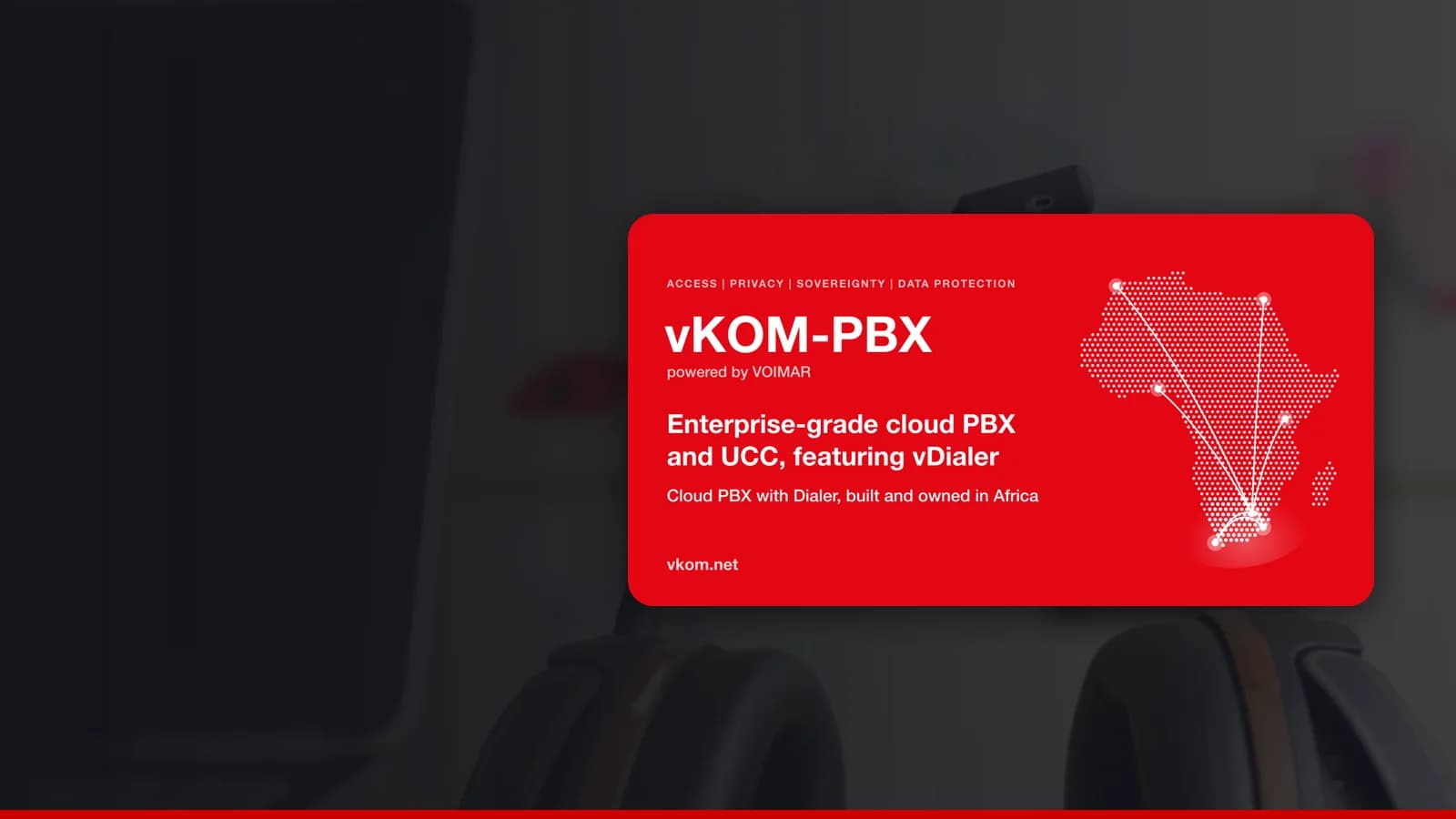
vKOM is one code base that we run as two instances. vKOM-PBX is the hosted phone system for business and the public sector: numbers, extensions, IVR menus, queues and voicemail, with vDIALER on every extension. vKOM-SECURE is the secure voice platform for police, defence, intelligence and government, hosted in South Africa on VOIMAR hardware or inside the customer's own network, with no foreign cloud in the call path. Inside the company we call it two doors, one house: the same rooms behind each door, a different door for a different visitor.
This is what sits behind the doors, how we are moving customers across from the older platform without a password or a PIN being retyped into the platform, and why the console looks the way it does. The migration is under way and not finished. The older platform runs in parallel today, and we say so wherever it matters.
What we built
vKOM has three parts. The Manager is the console and the record: customers, extensions, numbers, ring groups, IVR menus, queues, office hours, budgets, security lists and the audit trail. The Switch is the edge that every desk phone, softphone and browser registers to, and where floods, scanners and password guessing are detected and banned. The call nodes carry the calls. The design places a call node per region and lets any node carry any customer. Today the nodes do not yet sit in separate cities; that is a next step, not a claim.
The platform is multi-tenant from the ground up. Every customer is kept apart from every other, with its own extensions, numbers, limits and administrators. VOIMAR, a reseller and a customer administrator each see only their own scope, every switch of scope is audited, and sign-in is Voimar ID with two-step for every account.
The two instances share every line of code. One setting at start-up tells an instance which product it is, and that choice drives the brand, the menus and the rules at the edge. vKOM-PBX is red, accepts standard SIP desk phones beside vDIALER, and is sold online. vKOM-SECURE is olive, accepts only encrypted signalling from phones and browsers, refuses plain SIP from the internet except from approved carriers, and adds an Intelligence menu group that the business door does not show, beside the tools the security cluster needs: missions, security lists, prepaid wallets, PIN dialling, and the rule that no limit, budget or credit balance stops an emergency call. A fix made behind one door lands behind both. That is the whole reason for one house.
How it works
The console was designed by our CEO. He set the look and feel of both consoles and their three primary menu groups, Overview, Voice and Operations, and drew the dashboard and the extension screens. Our engineering notes record it as a major contribution from the VOIMAR CEO, and we built it as drawn. Queues, the IVR Builder and Office Hours followed in the same frame, and the menus come from VOIMAR's central menu registry, so both consoles and our other platforms change together instead of drifting apart.
vKOM exposes a provisioning interface that our order engine calls with a platform write key. It creates the customer, the extensions and the numbers by itself, and every SIP key it issues is bound to one customer and to one softphone backend, so a key lifted out of its place is useless anywhere else. Each call to the interface is audited against the order number. Number stock and the hold on a chosen number live in Voice Core, and vDIALER receives its side of the set-up from the same chain. One step is still done by a person: pointing the number at the new instance at our session border. An order is only instant when it is instant, so we say that plainly.
Security events flow one way. Each Switch bans attackers on its own and publishes its bans read-only. Voice Core collects them, with the blocks at the session border, onto one Voice Security page for VOIMAR's team.
Moving a customer without retyping a secret
The hard part of leaving an older phone platform is never the software. It is the small secrets that make phones work: the SIP password in every phone, the PIN on every voicemail box, the ring group nobody wrote down. Ask customers to re-enter those and the migration fails on the day.
So the importer copies all of it. For each customer on the migration list it reads the extensions, ring groups, IVR menus and queues from the older platform and creates them on vKOM-PBX. SIP usernames keep the same shape, customer code plus extension, so vDIALER keeps working with what it already holds. SIP secrets move machine to machine in their stored form: carried, never displayed, never typed. Voicemail PINs move the same way, under one rule. A PIN is written into a store that only the phone system role can read, and that is enforced in the database, not in the application. The Manager role, which the console and every administrator use, can add a PIN but can never read, change or delete one, and no report, export or log carries a PIN. That is the point.
A voicemail PIN is readable by the phone system, and never by the console or anyone who signs in to it.
Where we stand: every customer on the migration list has been imported into vKOM-PBX with their extensions, ring groups, IVR menus, queues, SIP secrets and voicemail PINs. No customer has been moved. The older platform carries every live call today and will run in parallel until each customer is switched, one at a time. We will not call this done until it is.
What it means for you
- Moving from the older platform: your extensions, ring groups, menus, queues, SIP secrets and voicemail PINs come with you. No secret is retyped into the platform, and vDIALER keeps working as it is.
- Buying vKOM-PBX online: the platform creates your customer record, your extensions and your numbers by itself, and your vDIALER sign-ins follow.
- On vKOM-SECURE: the same code as the business platform, so every fix arrives behind your door too, plus the missions, prepaid, PIN dialling and emergency rules the security cluster needs, on hardware in South Africa with no foreign cloud in the call path.
- For every administrator: one console designed around how you think about a phone system, Voimar ID sign-in with two-step, and an audit trail of every change.
- For everyone: your voicemail PIN is yours. The console cannot show it to anyone, us included.
What we have measured
We print fewer numbers here than we would like, on purpose. The import produced a report of everything it created across the migration list, with SIP secrets and voicemail PINs carried across, and customer counts stay out of public copy as a rule. Capacity figures exist for the design, but no capacity measurement has been run on either instance, so we do not print them.
What is next
- Switch customers off the older platform one at a time, and retire it only when the last one is across.
- Call nodes in separate cities, so that regional fail-over is a fact on the ground and not a line on a diagram.
- Voice Core producing the session-border change for each new order as a reviewable change set, so the last human step becomes a review and not a retype.
- Live Calls and a live extensions board in the console, and call recordings filed into the Record Store behind the POPIA Bridge.
Two doors, one house. For the first time, the house is ours.
Motsamai Mokgele Mokhomo Sr. designed the console both instances share, its menu groups Overview, Voice and Operations and its dashboard and extension screens, and he sets the product vision that puts a sovereign voice platform in front of government and business.
Zuko Leonard Rabotapi leads the engineering team that runs vKOM-PBX as a separate instance of the same code, set the rules the importer follows for SIP secrets and voicemail PINs, and oversaw the releases of both instances.