
A government runs on conversations. Ministers and their offices, committee staff in parliament, boards of state-owned companies and directors-general talk all day, and most of that talk now happens in chat apps and video calls. The uncomfortable question is who else can read it. A foreign platform answers to foreign laws and foreign owners, and whoever owns the technology can read it, hand it over or switch it off.
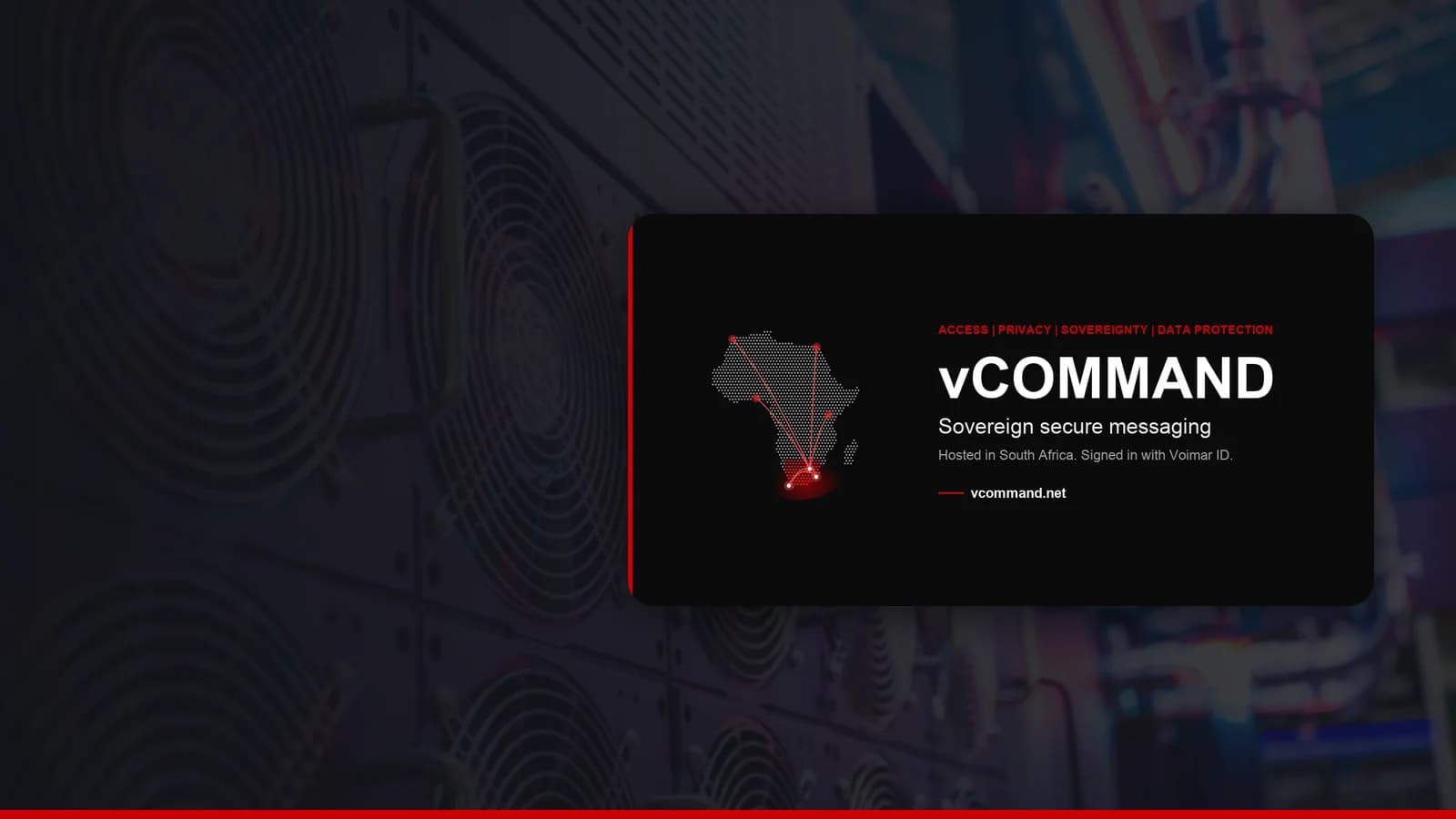
vCOMMAND is our answer. It is VOIMAR's messaging, calls and video platform for the state, built on the open Matrix standard and hosted on our own servers in South Africa. People sign in with Voimar ID. vCOMMANDER is our own client for the platform, and it is where new VOIMAR capabilities land first.
What we built
The first decision came in August. Our CEO set the direction for what became vCOMMAND: build it on the open Matrix standard, run the server ourselves and offer it as a VOIMAR service, and review the position after three months. An open standard means the protocol is published, the server runs on our own hardware, and no single company holds the keys to the room. It also means a department that already runs its own Matrix server can talk to ours, by its own choice.
The second decision came at the end of October. We had been running the platform with the standard client, and the question was whether VOIMAR should build its own. The CEO backed building and owning it. The client is where a government user meets the product, and the things a government asks for, a dial pad next to the chat, a warning before you send to the wrong group, a shop that never charges without confirmation, belong in software we control. On 29 October the platform became vCOMMAND and the client became vCOMMANDER.
vCOMMAND runs on open-source software from the Matrix community, used under its open-source licences, and we are grateful for it. What VOIMAR builds and owns is what sits around it: vCOMMANDER, the phone gateway, and the integration with Voimar ID and Voice Core. We keep to the terms of those licences, and we claim nothing for VOIMAR that the community built.
What runs today:
- vCOMMAND: end-to-end encrypted messaging, rooms and spaces for every team, files and voice notes, one-to-one and group calls with screen sharing, and always-on video rooms.
- Voimar ID sign-in with two-step verification, and Secure Backup under a recovery key that only the person holds. VOIMAR cannot see it and cannot reset it.
- vCOMMANDER: the same account, rooms and people as vCOMMAND, with phone calls inside the app, disappearing messages, encrypted media and the shared VOIMAR app frame.
- A phone gateway that reaches the phone network from the platform, with numbers drawn from the Voice Core register.
vCOMMAND is positioned for the government cluster: ministers and their offices, parliament and provincial legislatures, boards of state-owned companies and parastatals, directors-general and municipal managers. For police, defence and intelligence we lead with vKOM-SECURE, and we make no certification claim for vCOMMAND.
How it works
Identity first. Every person gets a Voimar ID with two-step verification, and vCOMMAND accepts nothing else. Each device is verified once before it can read encrypted history, and VOIMAR cannot reset the recovery key: lose it with no trusted device left, and old encrypted messages cannot be read on a new phone.
Encryption on the device. Messages are encrypted on the device, and only the people in the conversation can read them. In encrypted chats, photos, videos, voice notes and documents up to 2 gigabytes are encrypted on the device before they leave it. Calls between people on the platform are encrypted too. A call to the phone network cannot be end-to-end encrypted, because the far end is an ordinary telephone, and the vCOMMANDER dial pad says so before you dial.
Phone calls from the Voice Core register. vCOMMANDER has a dial pad and a call history. When a person dials an outside number, the phone gateway asks Voice Core, our central register of numbers and call records, for a number at that moment, places the call through our session border controller, and releases the number at hang-up. The call record lands in Voice Core, VOIMAR's system of record for call records and numbers. Call in progress shows only when someone is really connected, and a room admin can end a call for everyone.
Advanced SecureComms. Matrix is the engine, and the privacy rules we wrote for vKONNECTOR's SecureChat are the policy. Every control is a user choice: the server keeps the standard's defaults and the person or the room's admins decide. Disappearing messages run per chat with timers from 1 hour to 7 days, set by the chat's admins, with your own default for new chats. The server deletes a message when its timer runs out. A device that already holds it keeps its copy until it refreshes, and we say so rather than promise what we cannot enforce.
Who will read it. Every group in vCOMMANDER shows who is in it, flags anyone outside your organisation or only invited, and tells you who you are sending to before you send. My Notepad is a private encrypted room with only you in it, pinned to the top of your chats.
Push and the app frame. Push notifications reach the standard Matrix apps on a phone, so a message still arrives while the app is closed. vCOMMANDER runs in the browser, adds to the phone's home screen with its own icon, and shares one app frame with vDIALER, vKONNECTOR, vSMS and vAPN: the same product menu, bottom bar and top bar, and the same Shop as vKONNECTOR and vDIALER. The Shop charges nothing until you press Confirm, and never more than the price you confirmed.
Talking to other servers. vCOMMAND can reach other organisations' servers on the open Matrix standard, and you can invite outside people. That is a choice, and we say plainly what it means: a room shared with another server is shared with that server. Rooms kept inside vCOMMAND stay on our servers in South Africa.
What it means for you
- Your conversations sit on VOIMAR infrastructure in South Africa, run by a team in the country. No foreign cloud holds them.
- One sign-in. The same Voimar ID opens vCOMMAND, vCOMMANDER and every other VOIMAR app.
- Chat, files, meetings and calls in one place, with phone calls to the outside world arriving in stages.
- In vCOMMANDER you see exactly who can read a message before you send it, and you choose your own privacy controls instead of inheriting ours.
- Offices that keep Microsoft Teams can still reach the phone network through VOIMAR with Direct Routing. Teams stays where it is; vCOMMAND is for the conversations that must stay at home.
True sovereignty is when Africa is not just the driver, but the owner of the keys to the car.
What we measured where numbers exist
Media up to 2 gigabytes, encrypted on the device. Disappearing-message timers from 1 hour to 7 days. The routes that carry vCOMMAND calls to the phone network went in on 30 October, and a call through them was answered the same day. The phone gateway went through a full review and a fix-verification pass, and it still serves only our own staff. Availability is agreed in writing for each project.
What is next
Phone calling is being opened in stages: today the gateway serves VOIMAR's own people, and departments follow, each account added by approval. vCOMMANDER access works the same way: organisations ask, and each account is added by approval.
- vCOMMANDER's own push notifications, so a closed app still rings. Today it receives messages and calls while it is open.
- Colleague voice and video calls inside vCOMMANDER. Today they open in the platform's call window, while phone-network calls already run in the app.
- An incoming-call screen for phone calls, and store apps for iPhone and Android after legal review.
- More Advanced SecureComms controls, each one a user choice and never a default we impose.
- Rating vCOMMAND calls in Voice Core, so a department's phone calls appear on its VOIMAR account.
Motsamai Mokgele Mokhomo Sr. set the direction for everything VOIMAR does on Matrix: the open standard as the foundation, the decision to build and own vCOMMANDER, and the positioning of vCOMMAND for government, parliament and state-owned companies.
Zuko Leonard Rabotapi leads the engineering team that built the platform and the client: the SecureComms policy of user choice, the phone gateway on the Voice Core register, calls inside the app, encrypted media and the shared VOIMAR app frame.