
On 12 November 2026 a global outage at Microsoft 365 disrupted e-mail, calendars and related services for organisations in dozens of countries. Government ministries in several countries reported that their work was affected, with no timeline for a fix during the first hours. Services have since been recovering.
This is not a story about one company. Every provider has bad days, VOIMAR included. It is a story about dependence: when a government's daily communications run on one foreign service, a fault far away can stop a ministry, a province or a municipality at home. The question for every sphere of government is no longer whether that can happen, but what we do about it.
What the state needs from its communications
- Conversations, files and meetings that stay in South Africa, under South African law.
- Work that continues when a foreign provider has a problem.
- Each institution in control of its own system, without being cut off from the others.
- Strong encryption by default, not by setting.
- An open standard, so no supplier, including VOIMAR, can lock the state in.
vCOMMAND: sovereign, federated, open
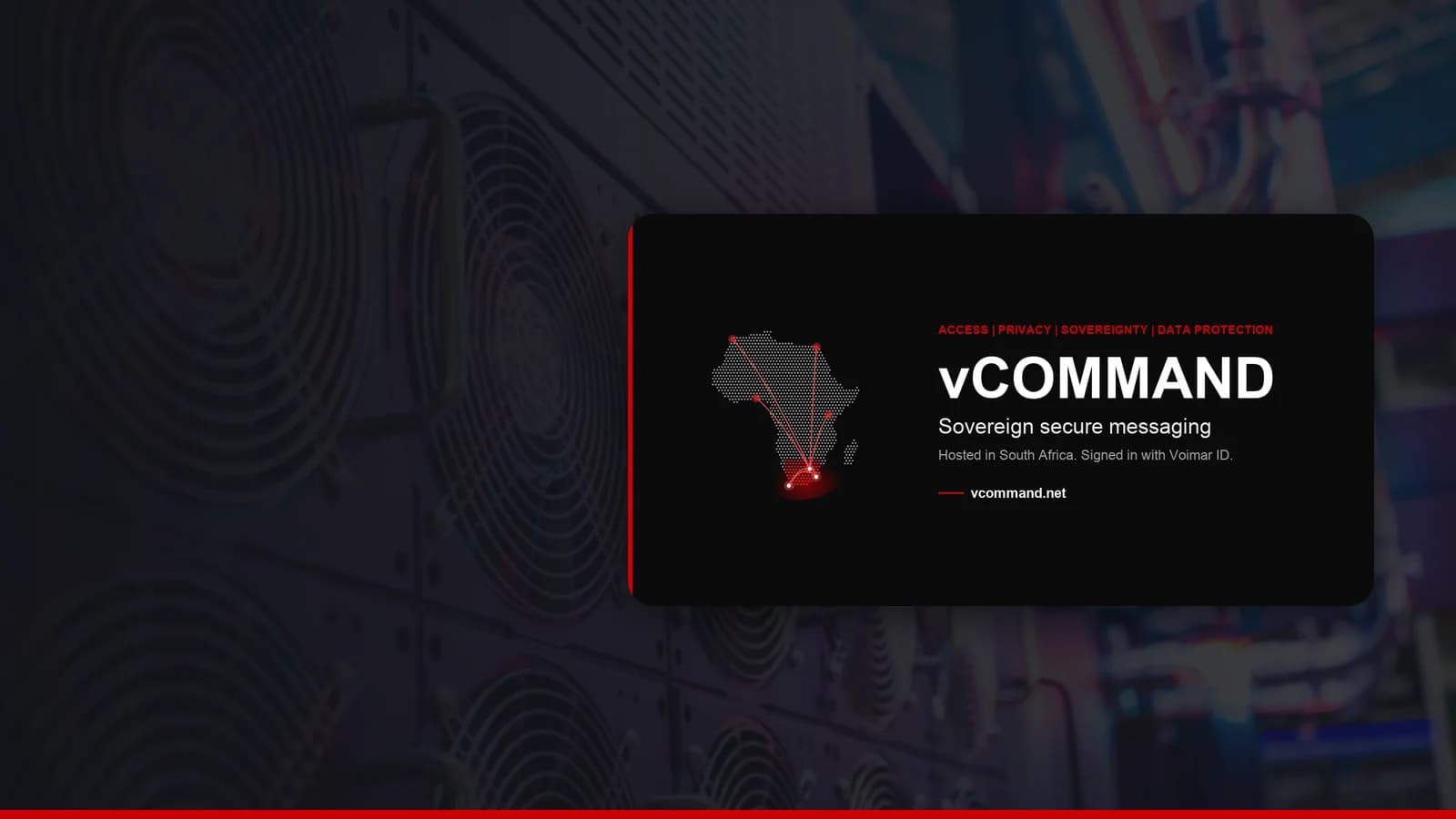
vCOMMAND is VOIMAR's messaging, calls and video platform for the state. It is built on Matrix, the open standard for secure, federated communication, and hosted on VOIMAR's own network in South Africa. Messages are end-to-end encrypted. People sign in once with a verified identity. Calls can reach the ordinary phone network.
Federation is what makes it fit government. Each national department, province, state-owned company or municipality can have its own vCOMMAND server, hosted by VOIMAR or run on its own premises, and keep control of its own users and records. Yet every server can talk securely to every other. A municipal manager, a provincial department and a national ministry can share a room for a disaster response without any of them giving up its data or its rules, and without a single point that can take them all down at once.
| What government needs | A single global cloud suite | vCOMMAND |
|---|---|---|
| Records stay in South Africa | Depends on the provider and the contract | Yes, today |
| Each institution controls its own server | No | Yes, today |
| Institutions communicate across spheres (federation) | Rarely (0 of 4 reviewed) | Yes, today |
| End-to-end encrypted messages | Some (1 of 4 reviewed) | Yes, today |
| Phone network calling built in | Rarely (0 of 4 reviewed) | Yes, today |
| A fault in one place does not stop everyone | No: one provider, one failure domain | Yes: each server stands on its own |
| Open standard, no lock-in | No | Yes, today |
A path for every sphere of government
- National departments: a sovereign platform for ministries and their agencies, with rooms that span departments.
- Provinces: each province on its own server, federated with national government and with its municipalities.
- State-owned companies: secure operational communication, separate from the public internet's consumer apps.
- Local government: municipalities connected to each other and to their province, for service delivery and for emergencies.
Moving does not have to happen in one step. vCOMMAND can start beside the tools an institution already uses, beginning with the conversations that matter most: executive, security and emergency communications.
The opportunity
This week's outage is a reminder, not a crisis to exploit. The right response is a plan: sovereign communications for the conversations the state cannot afford to lose, on an open standard, run in South Africa, with each institution in charge of its own. That is what vCOMMAND is built to do, and we invite every sphere of government to discuss it with us.
Sovereignty is not a slogan. It is the ability to keep working when someone else's system stops.
Motsamai Mokgele Mokhomo Sr. leads VOIMAR's strategy for government and sets the direction of vCOMMAND.
Zuko Leonard Rabotapi leads the engineering and operations teams that build and run vCOMMAND.